Queensland home insurance estimates, tested against real premiums
Every SuburbCost suburb page shows an estimate of what building insurance costs on the same standard house. This study shows where that estimate comes from in Queensland and tests it, area by area, against what the ACCC reports households actually pay. It also sets out what we got wrong before 6 November 2026 and what we changed.
SuburbCost estimates building insurance for the same standard house in every suburb, insured for $600,000, using the ACCC's 2026 premium rates for each area's cyclone risk. In Queensland the estimate is a median $2,150 a year where cyclone risk is low and $3,600 in the medium to high risk north. Tested against the ACCC's averages of what households pay for building and contents combined, our building-only estimate sits below that average in 60 of 73 Queensland areas and within it in 13. Before 6 November 2026 our earlier estimates sat above it in 15 areas, which is why we changed the method.
Key statistics
- Estimate, low cyclone risk areas
- $2,150/yr
- Estimate, the cyclone-rated north
- $3,600/yr
- Areas where our estimate is below the ACCC average
- 60 of 73
- Areas above it before the fix
- 15
Estimates are building cover for a standard $600,000 house. ACCC figures are averages of what households paid for combined home and contents cover in 2025.
Cyclone risk sets the starting point
The ACCC publishes the average premium per $100,000 insured by cyclone risk. We apply that rate to one standard house insured for $600,000 in every suburb, so suburbs are compared on the same home rather than on what the homes in them are worth. Each area's cyclone rating comes from the cyclone reinsurance pool's risk bands.
| Cyclone risk | Where | ACCC average per $100,000 insured | Standard house before flood and fire | Suburbs | Our median estimate |
|---|---|---|---|---|---|
| Medium to high | Cairns, Townsville and Mackay regions | $606 | $3,636 | 350 | $3,600 |
| Low | the rest of Queensland, including the south-east | $359 | $2,154 | 1,265 | $2,150 |
Those are area figures. See the estimate for the suburbs on your shortlist →
Where there is no cyclone risk the rate is $306, or $1,836 for the standard house. That applies to most of New South Wales and all of Victoria, not to Queensland.
Within each area, a suburb with higher flood or fire risk is estimated above its neighbours and a safer one below them, which is why estimates run from $900 to $3,750 in the low cyclone risk areas and from $2,250 to $4,450 in the north.
Tested against what households pay
The ACCC also reports the average premium households actually paid for combined building and contents cover in each ABS SA3 area. That is a different product from our estimate: it includes contents, and it reflects each household's own home and sum insured. So a building-only estimate for a standard house should normally sit at or below it, and never above it.
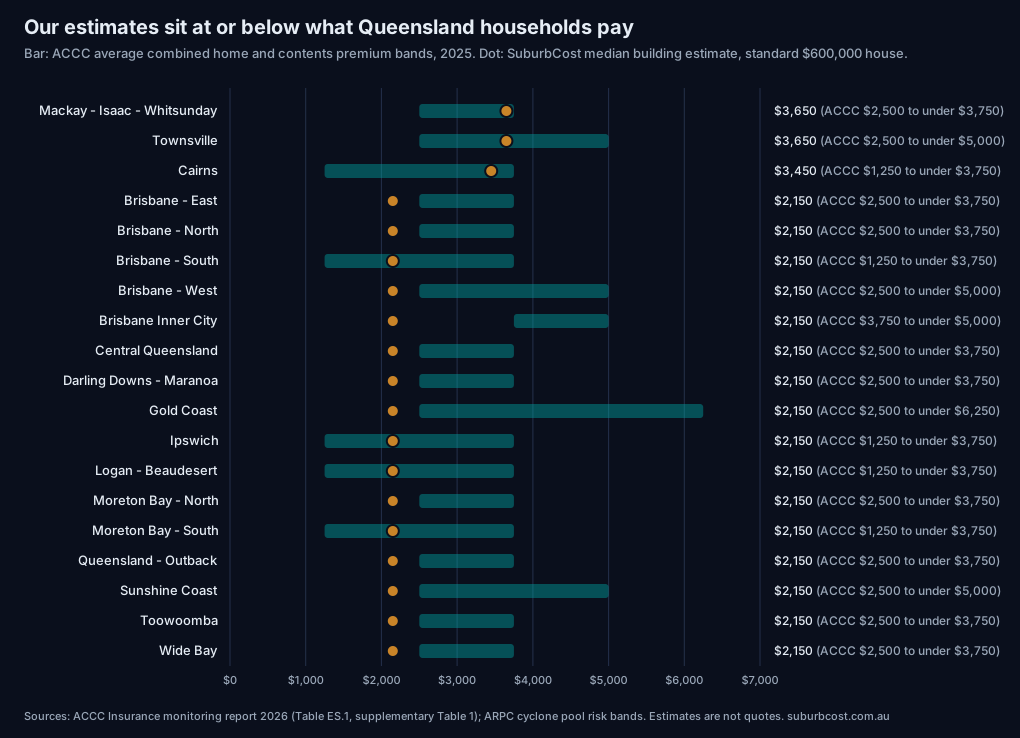
Across Queensland's 73 areas, our estimate sits below the ACCC average in 60 and within its band in 13. None is above it.
| Region | Suburbs | Our median estimate | ACCC average combined premium, range across the region's areas |
|---|---|---|---|
| Mackay - Isaac - Whitsunday | 86 | $3,650 | $2,500 to under $3,750 |
| Townsville | 94 | $3,650 | $2,500 to under $5,000 |
| Cairns | 170 | $3,450 | $1,250 to under $3,750 |
| Brisbane - East | 37 | $2,150 | $2,500 to under $3,750 |
| Brisbane - North | 32 | $2,150 | $2,500 to under $3,750 |
| Brisbane - South | 50 | $2,150 | $1,250 to under $3,750 |
| Brisbane - West | 36 | $2,150 | $2,500 to under $5,000 |
| Brisbane Inner City | 32 | $2,150 | $3,750 to under $5,000 |
| Central Queensland | 1 | $2,150 | $2,500 to under $3,750 |
| Darling Downs - Maranoa | 233 | $2,150 | $2,500 to under $3,750 |
| Gold Coast | 95 | $2,150 | $2,500 to under $6,250 |
| Ipswich | 225 | $2,150 | $1,250 to under $3,750 |
| Logan - Beaudesert | 97 | $2,150 | $1,250 to under $3,750 |
| Moreton Bay - North | 74 | $2,150 | $2,500 to under $3,750 |
| Moreton Bay - South | 43 | $2,150 | $1,250 to under $3,750 |
| Queensland - Outback | 63 | $2,150 | $2,500 to under $3,750 |
| Sunshine Coast | 135 | $2,150 | $2,500 to under $5,000 |
| Toowoomba | 94 | $2,150 | $2,500 to under $3,750 |
| Wide Bay | 9 | $2,150 | $2,500 to under $3,750 |
Regions are ABS SA4 areas; the ACCC reports bands for the smaller SA3 areas within them. The full area-by-area table is in the CSV below.
The gap is widest in expensive inner suburbs, where real homes are worth far more than our standard house and households insure them for more. That is deliberate. The estimate shows what living in the suburb costs on the same home, not what its homes cost to insure.
What we corrected on 6 November 2026
Until 6 November 2026 our insurance figures were AI estimates. When we tested them against the ACCC's 2026 figures, they sat above the average combined home and contents premium in 15 Queensland areas, which a building-only figure for a standard house should not do. The largest gaps were in the far north.
| Area | Earlier estimate (median) | Estimate now (median) | ACCC average combined premium |
|---|---|---|---|
| Tablelands (East) - Kuranda | $5,300 | $2,450 | $1,250 to under $2,500 |
| Far North | $5,600 | $2,150 | $2,500 to under $3,750 |
| Port Douglas - Daintree | $5,525 | $3,650 | $2,500 to under $3,750 |
| Cairns - North | $5,300 | $3,650 | $2,500 to under $3,750 |
The earlier estimates also put Cairns North $2,000 a year above Townsville for the median suburb, $5,300 against $3,300, though the ACCC's averages put Townsville a band higher. The new estimates are level, at $3,650 in both, because both areas carry the same cyclone rating.
Our estimates still do not rank areas the way the ACCC's averages do. Real premiums rise with home values, so dear inner suburbs pay more, and a same-house estimate leaves that out on purpose.
Why the north still costs more
The ACCC's average premium per $100,000 insured in medium to high cyclone risk areas, $606, is about two thirds more than the $359 paid where the risk is low. Northern premiums have fallen since the cyclone reinsurance pool began in 2022. The ACCC reports average home and contents premiums, adjusted for sums insured, down 14% in Mackay and 12% in Cairns after insurers joined the pool.
What an estimate cannot tell you about one home
- The sum insured. Rebuild cost depends on size, finish and construction. A bigger or higher-spec home costs more to insure.
- The exact address. Flood and storm surge are priced address by address, and a suburb rating is only a guide. Check the official flood map for the property.
- Your cover and excess. A higher excess lowers the premium; extra cover raises it.
- Units. Building cover for units is usually paid through the body corporate levy. Unit figures on SuburbCost are contents cover.
- Your insurer. Prices for the same home differ between insurers. Moneysmart's home insurance guidance covers what to compare.
Method and sources
Estimate per suburb: the standard $600,000 sum insured times the ACCC's average premium per $100,000 insured for the area's cyclone risk, times the suburb's flood and fire difference from its SA3 neighbours (taken from the earlier estimates), capped at the top of the SA3's ACCC combined premium band, rounded to $50. Medians are across suburbs. Earlier estimates are the AI estimates in use until 6 November 2026.
- ACCC, Insurance monitoring report 2026: Table ES.1, average premium per $100,000 sum insured by cyclone risk; supplementary data Table 1, average combined home and contents premium band by SA3, 2025; executive summary, post pool premium falls.
- Australian Reinsurance Pool Corporation, Cyclone Pool Premium Assessment, May 2025: wind risk bands by region, grouped as the ACCC groups them.
- ABS Australian Statistical Geography Standard 2021, SA3 and SA4 boundaries, to place each suburb in its area.
The full method is on the methodology page. Download the area-by-area table as a CSV. For reuse, the press kit has the regional chart and a plain text summary.
Frequently asked questions
How much is home insurance in Queensland?
It depends on the home, the insurer and the cover, so no single figure applies. As a guide, SuburbCost's estimate for building insurance on a standard $600,000 house is a median $2,150 a year in the low cyclone risk parts of Queensland, including the south-east, and $3,600 around Cairns, Townsville and Mackay. These are estimates for comparing suburbs, not quotes. The ACCC reports that households across Queensland's areas pay from $1,250 to under $6,250 a year on average for combined building and contents cover, depending on the area.
Why is home insurance dearer in north Queensland?
Cyclone risk. The ACCC's figures put the average premium per $100,000 insured at $606 in medium to high cyclone risk areas against $359 where the risk is low, about two thirds more. Premiums in the north have fallen since the cyclone reinsurance pool began in 2022: the ACCC reports falls of 14% in Mackay and 12% in Cairns, adjusted for sums insured.
Are these real insurance quotes?
No. They are estimates for one standard house, so suburbs can be compared on the same basis. Your premium depends on your home's size and construction, its exact location and flood exposure, the cover and excess you choose, your claims history and your insurer. Get quotes before you budget.
Why did SuburbCost change its insurance estimates?
A check against the ACCC's 2026 figures found that our earlier AI estimates sat above the average combined home and contents premium in 15 Queensland areas, which a building-only figure should not do. On 6 November 2026 we moved every suburb to ACCC rates for its cyclone risk.
See what a suburb costs to run
Council rates, water, estimated insurance, electricity and your commute for up to five suburbs, side by side and ten years out.
Get the free suburb running cost report →